
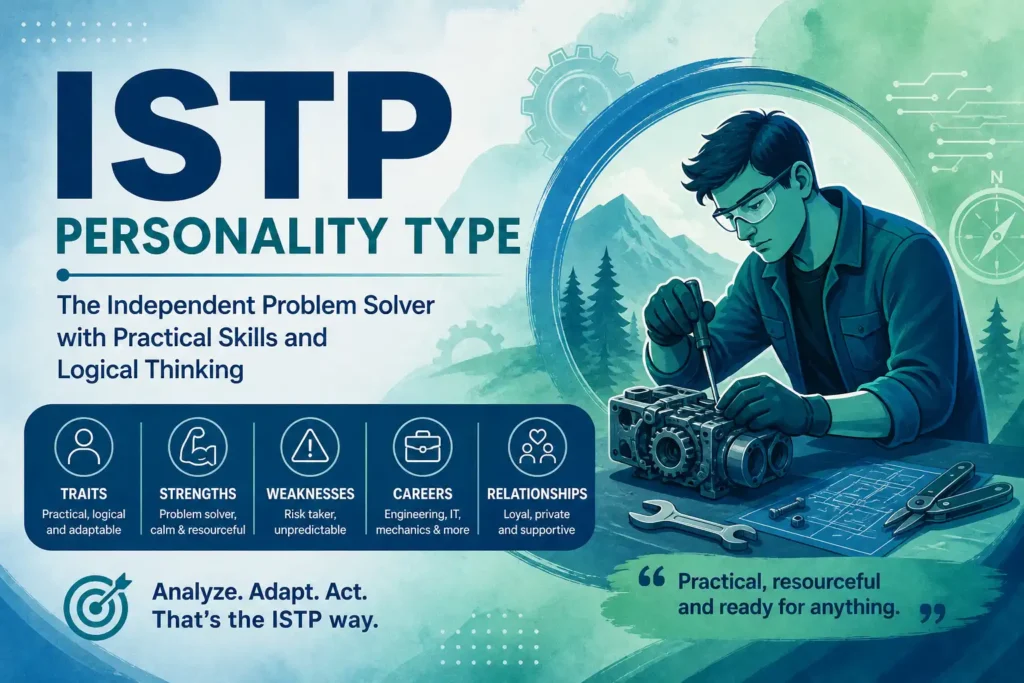
ISTP Personality type are generally described as practical, independent, adaptable, and analytical people who enjoy understanding how things work and finding practical solutions to problems. They often prefer dealing with facts and real-world situations rather than spending too much time on abstract theories.
An ISTP may be comfortable working independently, responding quickly to changing circumstances, and solving problems when something goes wrong. Their calm approach can be particularly valuable in situations that require immediate action and practical thinking.
ISTPs also tend to value freedom and flexibility. They may prefer having the opportunity to explore, experiment, and decide how to approach a task rather than following unnecessary rules or rigid procedures.
However, personality type describes preferences and tendencies rather than fixed behavior. Not every ISTP will display all of these characteristics, and individual personality is also influenced by experience, education, culture, environment, values, and personal development.
What Does ISTP Stand For?
ISTP is one of the 16 personality types described by the Myers-Briggs Type Indicator (MBTI). The four letters represent:
- I – Introversion: Generally prefers quieter environments, independent activities, and time for reflection.
- S – Sensing: Generally focuses on facts, details, practical information, and present realities.
- T – Thinking: Tends to make decisions using logic, analysis, and objective considerations.
- P – Perceiving: Generally prefers flexibility, spontaneity, and keeping options open rather than having everything decided in advance.
Together, these preferences are commonly associated with a practical, analytical, flexible, and action-oriented approach to life.
Common Traits of ISTP Personality
ISTPs are often practical thinkers who prefer learning through direct experience. They may enjoy examining how things work, identifying the cause of a problem, and finding an efficient way to solve it.
Some common ISTP personality traits include:
- Practical and realistic
- Independent and self-reliant
- Analytical and logical
- Adaptable and flexible
- Calm under pressure
- Interested in how things work
- Good at troubleshooting
- Comfortable responding to immediate problems
- Open to new experiences
- Result-oriented
- Prefer freedom and independence
- Often enjoy hands-on activities
- Willing to take calculated risks
ISTPs may be particularly effective when they can combine observation, analysis, and action. Instead of spending a long time discussing a problem, they may prefer to understand the situation and start working on a solution.
ISTP – The Craftsman
ISTPs are often associated with the nickname “The Craftsman.” This reflects their practical and hands-on approach to understanding the world.
They may enjoy working with tools, technology, machines, systems, equipment, or other practical activities. Their interest is often not simply in knowing what something is, but in understanding how it works and how it can be improved or fixed.
ISTPs can also be effective in difficult or unexpected situations because they may remain relatively calm and focus on the problem immediately in front of them.
Their adaptability allows them to change their approach when circumstances change. Rather than following a fixed plan at all costs, they may prefer to assess the situation and determine what will work best at that moment.
Strengths of ISTP Personality Type
Like every personality type, ISTPs have both strengths and areas that may require development. Their strengths can become particularly valuable when used in appropriate environments.
1. Optimistic and Resilient
ISTPs may have a practical and relatively positive approach to difficult situations. Rather than becoming overwhelmed by a problem, they may focus on what can be done immediately.
Their ability to learn from experience can also help them become more confident when dealing with future challenges.
2. Flexible and Spontaneous
Flexibility is one of the commonly associated strengths of ISTPs. They can often adjust their approach when circumstances change.
Instead of depending completely on a predetermined plan, they may assess the current situation and modify their actions accordingly.
This ability can be particularly useful in fast-changing environments.
3. Calm Under Pressure
ISTPs are often described as calm and composed in difficult situations. They may focus on the practical aspects of a problem instead of reacting emotionally.
This can make them effective troubleshooters when quick action is required.
4. Practical and Realistic
ISTPs generally prefer practical solutions that can actually be implemented. They may be good at understanding how something works and identifying what needs to be changed to produce a desired result.
Their practical approach can be useful in engineering, technology, mechanics, operations, troubleshooting, and many other areas.
5. Continuous Learners
ISTPs may learn particularly well when they have an opportunity to explore a subject through practical experience.
When they become interested in a topic, they can spend considerable time understanding how it works and developing the skills required to use that knowledge.
6. Organized When It Serves a Purpose
Although ISTPs may dislike unnecessary structure, they can be highly organized when organization helps them accomplish a practical objective.
They may use lists, applications, calendars, tools, or other systems when these make their work more efficient.
7. Effective Team Contributors
ISTPs may prefer working independently, but this does not mean they cannot work effectively in teams.
They can contribute valuable practical knowledge, technical skills, troubleshooting ability, and objective analysis to a team. Their relatively non-judgmental approach can also help them work with people who have different viewpoints.
8. Willing to Take Risks
ISTPs may be comfortable with calculated risks, particularly when they believe the potential outcome is worth pursuing.
This willingness to act in uncertain situations can create opportunities. However, risk-taking needs to be balanced with careful consideration of possible consequences.
Weaknesses and Challenges of ISTP Personality Type
The same characteristics that create strengths can sometimes become challenges when taken too far. Understanding these areas can help ISTPs improve their personal and professional effectiveness.
1. May Appear Overly Detached
ISTPs often rely strongly on logic and practical reasoning. As a result, other people may sometimes perceive them as distant, unemotional, or insensitive.
This does not necessarily mean that ISTPs do not care about others. They may simply express care through practical actions rather than emotional words.
2. Strong Focus on the Present
ISTPs often concentrate on what is happening now. This can help them respond effectively to immediate problems, but an excessive focus on the present may make long-term planning more difficult.
Important decisions sometimes require considering future consequences rather than only solving the immediate problem.
3. May Avoid Long-Term Commitments
A strong preference for freedom and flexibility can make some ISTPs uncomfortable with commitments that feel restrictive.
This may appear in professional projects, relationships, schedules, or long-term plans. Developing a balance between independence and commitment can be an important area of growth.
4. Can Become Overly Risk-Taking
Risk-taking can be useful when supported by good judgment. However, acting too quickly without considering consequences may lead to unnecessary problems.
ISTPs can benefit from distinguishing between calculated risk and impulsive risk.
5. May Appear Unpredictable
ISTPs may change their plans when circumstances change or when they become interested in something new. While flexibility is useful, frequent changes can sometimes make them appear unpredictable to others.
Communicating changes clearly can help reduce misunderstandings.
6. May Underestimate Emotional Factors
ISTPs often approach problems logically and may naturally focus on finding solutions. In some situations, however, people need to be heard and understood before they need a solution.
Developing emotional awareness and communication skills can therefore strengthen ISTPs’ personal and professional relationships.
ISTP in the Workplace
ISTPs may prefer workplaces that provide freedom, practical challenges, variety, and opportunities to solve real problems.
They can be particularly effective when they are given a problem and enough autonomy to determine how to solve it.
ISTP as a Manager or Leader
As managers, ISTPs may prefer an informal and flexible leadership style. They may give employees considerable independence rather than constantly monitoring their work.
They can be especially useful during difficult situations because they may remain calm and focus on practical solutions.
However, ISTP managers may need to pay attention to communication, feedback, and employee emotions. Employees may require more guidance and recognition than an ISTP naturally thinks is necessary.
ISTP as a Colleague
As colleagues, ISTPs may contribute practical knowledge and troubleshooting skills. When a machine, system, process, or project encounters a problem, they may prefer to find a workable solution rather than spend too much time discussing the problem.
Their logical communication style can be useful, although they may sometimes need to be more aware of how direct comments are perceived by others.
ISTP as an Employee or Subordinate
ISTPs may perform well when they have clear objectives but sufficient freedom in how they complete their work.
They may dislike excessive bureaucracy, unnecessary rules, or constant supervision. Short-term targets and tangible results can sometimes be more motivating than lengthy planning processes.
Their adaptability and ability to respond to unexpected problems can make them valuable members of an organization.
Career Choices for ISTPs
ISTP personality characteristics may be compatible with careers involving practical problem-solving, technical skills, troubleshooting, independence, variety, and real-world challenges.
However, personality type should never be used as the sole basis for choosing a career. Education, qualifications, interests, skills, values, experience, financial goals, and available opportunities are equally important.
Some ISTPs may find aspects of the following career areas compatible with their preferences:
- Engineering
- Mechanical and automotive fields
- Computer programming and software
- Computer hardware and systems
- Technical and specialist roles
- Forensic science
- Aviation
- Emergency services
- Police and investigative work
- Military and defence-related careers
- Electrical and electronics work
- Manufacturing and plant operations
- Surveying and inspection
- Geology and field-based work
- Skilled technical trades
- Operations and troubleshooting
- Design and hands-on technical fields
- Entrepreneurship
ISTP Work Environment
ISTPs may particularly enjoy work environments that provide:
- Practical problems to solve
- Freedom and independence
- Variety and new challenges
- Tangible results
- Opportunities for hands-on work
- Technical or analytical challenges
- Flexible working methods
- Opportunities to respond to unexpected situations
They may find environments less engaging when work is dominated by unnecessary bureaucracy, repetitive procedures, excessive supervision, or theoretical discussion with little practical application.
This does not mean that an ISTP cannot succeed in a highly structured profession. Rather, the actual nature of the role and the individual’s interests and abilities matter more than personality type alone.
ISTP in Relationships
ISTPs often value independence, personal space, flexibility, and authenticity in relationships.
They may prefer relationships that allow both people to maintain their individuality rather than relationships based on constant interaction or control.
They may also show care through practical support and actions rather than frequent emotional expression.
ISTP as a Partner
ISTPs may enjoy relationships that provide freedom, variety, and opportunities for shared experiences. They may prefer taking a relationship one step at a time rather than planning every aspect of the future.
They can be practical problem solvers and may remain calm when their partner faces difficulties.
However, their need for independence and relatively limited emotional expression may sometimes create misunderstandings. A partner may want more emotional communication or reassurance than the ISTP naturally provides.
Learning to communicate feelings openly and discussing long-term expectations can strengthen the relationship.
ISTP as a Parent
ISTP parents may encourage children to explore, experiment, and develop independence. They may prefer allowing children to learn through experience rather than controlling every aspect of their development.
They can be particularly good at teaching practical skills and encouraging curiosity.
However, children may also need emotional reassurance and verbal expressions of affection. ISTP parents can benefit from consciously creating opportunities for emotional connection rather than focusing only on practical solutions.
ISTP as a Friend
ISTPs can be relaxed, open-minded, and dependable friends. They may enjoy friendships based on shared interests, hobbies, activities, and experiences.
They may not require constant communication to maintain a friendship and may be comfortable giving friends personal space.
At the same time, their flexible approach and preference for independence can sometimes make relationships appear less predictable. Clear communication can help maintain stronger friendships.
Personality Development for ISTPs
Personality development does not mean changing who you are. It means learning how to use your natural strengths effectively while developing skills that may not come as naturally.
ISTPs can benefit from focusing on the following areas.
1. Develop Long-Term Thinking
Practical problem-solving is a major strength, but some goals require long-term planning. Learning to balance immediate action with future consequences can improve decision-making.
2. Strengthen Emotional Communication
ISTPs can benefit from expressing feelings more openly and recognizing that not every problem requires a practical solution.
Sometimes people simply need understanding and support.
3. Think Before Taking Risks
Risk-taking can create opportunities, but it should be supported by an assessment of potential consequences.
Developing a habit of asking “What could go wrong?” before taking major risks can improve decision-making.
4. Communicate Changes Clearly
Flexibility is valuable, but frequently changing plans without informing others can create confusion.
Explaining why a plan has changed can help maintain trust in professional and personal relationships.
5. Build Commitment and Consistency
Freedom and variety are important, but some goals require persistence even after the initial excitement disappears.
Developing consistency can help ISTPs turn their practical abilities into long-term achievements.
6. Balance Logic with Empathy
Logical thinking helps solve problems, while empathy helps understand people.
Learning to use both can make ISTPs more effective leaders, colleagues, partners, parents, and friends.
Famous People Associated with ISTP
Some public figures have been popularly identified or described as having an ISTP personality type, including Sir Edmund Hillary, Tom Cruise, Bruce Lee, Scarlett Johansson, Zachary Taylor, Vladimir Putin, the Dalai Lama, Ernest Hemingway, and Magnus Carlsen.
However, personality classifications of public figures should be treated cautiously. Unless a person’s MBTI assessment is publicly documented, assigning a personality type to a historical or public figure is interpretive rather than confirmed.
Frequently Asked Questions About ISTP Personality Type
Explore the 16 Personality Types
ISTP is only one of the 16 personality types. Explore the complete guide to discover the characteristics, strengths, weaknesses, career possibilities, workplace behavior, and relationships associated with all 16 types.
→ Explore the 16 Personality Types