
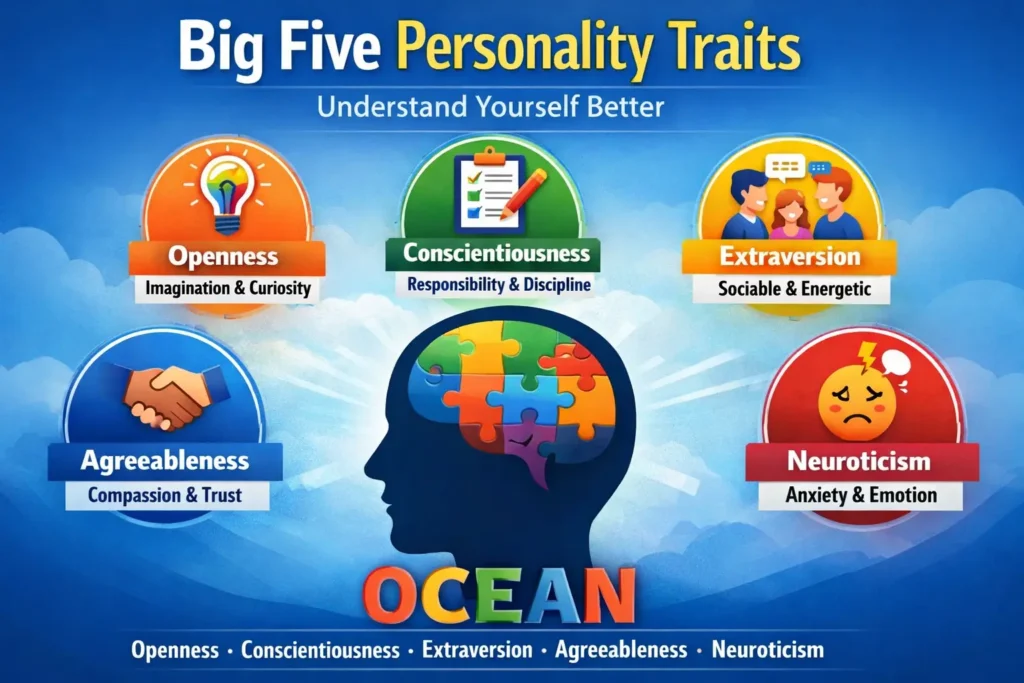
The Big Five Personality Traits are the most widely accepted model in psychology for understanding human behavior. Have you ever wondered why some people are highly organized while others are more spontaneous? Or why some individuals enjoy social gatherings while others prefer solitude?
The answer lies in five core personality dimensions that shape how we think, feel, and behave.
These traits are also known as the Five-Factor Model of Personality (FFM) or OCEAN personality traits, which include:
Each individual possesses these traits in varying degrees. Instead of fitting into a single category, people fall along a continuum between two extremes of each trait.
For example, a person may be highly disciplined (high conscientiousness) or more flexible and spontaneous (low conscientiousness).
Some researchers also propose an additional dimension called the Honesty–Humility (H factor), which reflects sincerity, fairness, and integrity.
Personality traits are not formed in isolation. They are influenced by various factors. To understand this better, read our article on Factors Affecting Personality Development.
Big Five Personality Traits
The Big Five personality traits help explain differences in human behavior and are widely used in psychology, education, and workplace settings.
Each trait represents a spectrum between two opposite tendencies. Let us explore each trait in detail.
1. Openness to Experience
Openness to Experience refers to a person’s willingness to explore new ideas, embrace creativity, and seek new experiences. It reflects imagination, curiosity, and intellectual flexibility.
Opposite: Closedness or resistance to change
1.1 Facets of Openness
1.2 Characteristics of High Openness
People high in openness tend to:
Example:
An artist who enjoys experimenting with new styles or a student who loves learning new subjects demonstrates high openness.
People low in openness are usually more traditional and prefer routine.
2. Conscientiousness
Conscientiousness reflects a person’s level of discipline, organization, and responsibility. It is one of the strongest predictors of long-term success.
Opposite: Impulsiveness or lack of discipline
2.1 Facets of Conscientiousness
2.2 Characteristics of High Conscientiousness
Individuals with high conscientiousness:
Example
A student who prepares a study schedule and follows it consistently shows high conscientiousness.
Such individuals are often seen as dependable and achievement-oriented.
3. Extraversion
Extraversion refers to the tendency to be outgoing, energetic, and socially active. Extraverted individuals gain energy from interacting with others.
Opposite: Introversion
3.1 Facets of Extraversion
3.2 Characteristics of High Extraversion
People high in extraversion:
Example
A sales professional who enjoys meeting new people and networking is likely high in extraversion.
Introverted individuals, on the other hand, prefer solitude or small groups.
4. Agreeableness
Agreeableness describes a person’s tendency to be kind, cooperative, and compassionate. It reflects how well individuals interact with others.
Opposite: Hostility or antagonism
4.1 Facets of Agreeableness
4.2 Characteristics of High Agreeableness
Individuals high in agreeableness:
Example
A team member who supports colleagues and avoids conflicts demonstrates high agreeableness.
Such individuals are generally perceived as friendly and trustworthy.
5. Neuroticism
Neuroticism refers to the tendency to experience negative emotions such as anxiety, stress, and mood swings.
Opposite: Emotional stability
5.1 Facets of Neuroticism
5.2 Characteristics of High Neuroticism
People with high neuroticism:
Example
An individual who becomes easily stressed before exams or overthinks situations may score high in neuroticism.
Those with low neuroticism are calm, stable, and better at handling pressure.
Research-backed explanations of emotional stability and personality traits can also be found on Big Five Personality Traits in the Psychology.
Applications of Big Five Personality Traits in Real Life
The Big Five Personality Traits are widely used in real-life situations:
Why Are the Big Five Personality Traits Important?
The Big Five personality traits are widely used in real-life applications because they help:
- Understand individual differences in behavior
- Improve self-awareness and personal growth
- Enhance communication and relationships
- Assist in career guidance and hiring decisions
- Support psychological research and assessment
Understanding these traits also helps individuals identify their strengths and areas for improvement.
Frequently Asked Questions (FAQ)
Final Thoughts
The Big Five Personality Traits provide a powerful framework for understanding human personality. Since every individual lies somewhere along each trait spectrum, these dimensions explain differences in behavior, thinking, and emotional responses.
By understanding the OCEAN personality traits, individuals can improve self-awareness, build better relationships, and work toward personal and professional development.
Related Posts

Strengths of INTJ Personality Type
INTJs are one of the rarest personality types who are “the scientists” or called as…

ISFPs in Workplace
ISFPs in workplace are good problem solvers who like to get positions which give room…

ENTP Personality Type
ENTPs are creative, intellectually quick people who highly value knowledge. They have the ability to…