
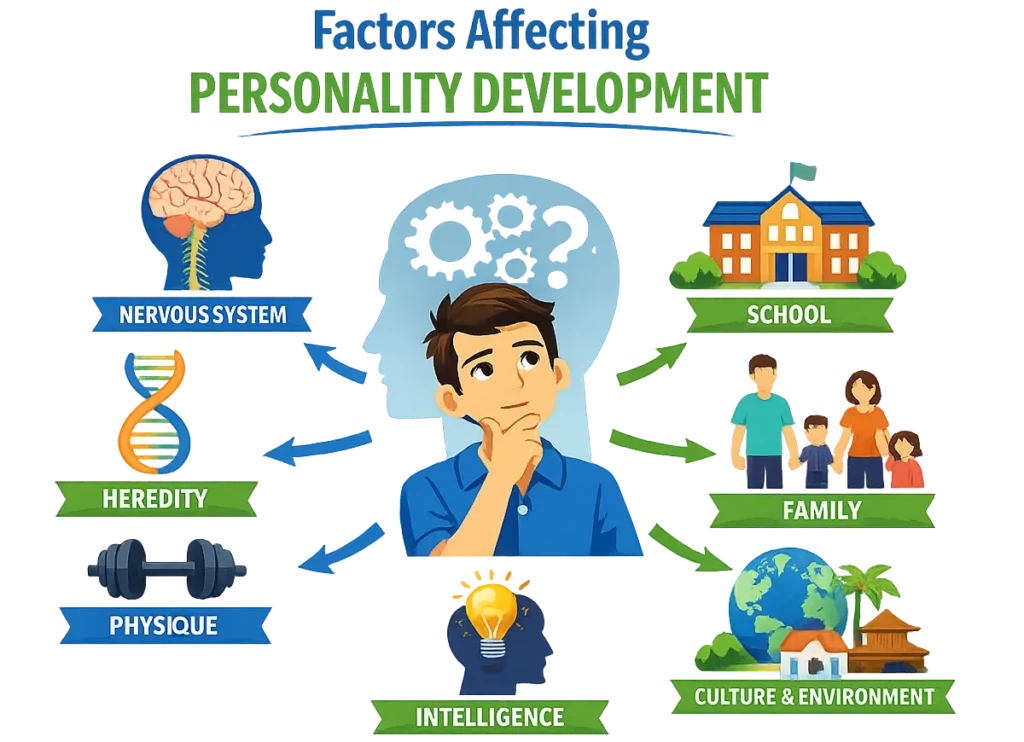
Personality plays a crucial role in determining how individuals think, behave, and interact with others in society. The factors affecting personality development shape a person’s attitudes, behaviour patterns, emotional responses, and social relationships throughout life.
Personality does not develop due to a single influence. Instead, it evolves gradually through the combined effects of biological characteristics, psychological traits, and environmental conditions. These influences interact with each other from childhood to adulthood, forming the unique personality of every individual.
Understanding the factors affecting personality development helps explain why people behave differently even when they grow up in similar circumstances. In psychology, personality development is generally influenced by two major groups of factors:
This article explains the major factors affecting personality development and how they influence human behaviour and personality growth.
- Meaning of Personality
- Major Factors Affecting Personality Development
- Individual or Personal Factors Affecting Personality Development
- Environmental or Social Factors Affecting Personality Development
- Other Factors Affecting Personality Development
- Frequently Asked Questions (FAQ)
- Final Thoughts
- Related Posts
Meaning of Personality
In psychology, personality refers to the unique combination of traits, emotions, attitudes, and behaviours that distinguish one individual from another.
Personality determines:
Personality development is therefore the process through which these traits gradually develop and become organized over time.
Various psychological studies, including research supported by the American Psychological Association, show that both biological and environmental influences contribute to the formation of personality.
For a deeper understanding of self-awareness in personality growth, you may also read our article on Personality Development and Johari Window.
Major Factors Affecting Personality Development
The factors affecting personality development can broadly be classified into two categories:
Both types of factors interact continuously throughout life and contribute to shaping an individual’s personality.
Individual or Personal Factors Affecting Personality Development
Individual factors are the biological and inherited characteristics of a person. These factors exist from birth and form the basic foundation of personality development.
Some of the most important personal factors affecting personality development are discussed below.
a) Heredity
Heredity refers to the genetic characteristics that are passed from parents to their children.
Inherited traits influence several aspects of personality, including:
For example, children may inherit certain behavioural tendencies or talents from their parents. These inherited traits form the biological foundation of personality development.
b) Physique
Physique refers to the physical structure and body type of a person.
Important physical characteristics include:
These characteristics can influence how individuals perceive themselves and how others perceive them. As a result, physique may affect self-confidence, social behaviour, and interpersonal interactions.
c) Biological Factors
Biological processes also play a significant role among the factors affecting personality development.
Some important biological influences include:
Endocrine glands such as the pituitary gland, thyroid gland, adrenal glands, and gonads produce hormones that regulate behaviour, emotions, and mood.
These biological mechanisms influence personality formation and behavioural responses.
d) Nervous System
The central nervous system, which includes the brain and spinal cord, plays a fundamental role in controlling behaviour.
The brain performs several important functions related to personality, including:
Differences in nervous system functioning can influence emotional reactions, stress management, and decision-making abilities.
e) Intelligence
Intelligence refers to a person’s ability to learn, understand, and solve problems.
Individuals with different levels of intelligence may:
These differences influence how individuals interact with their environment, making intelligence an important factor affecting personality development.
Environmental or Social Factors Affecting Personality Development
Environmental factors refer to the external conditions and social surroundings in which a person grows and lives.
These factors strongly influence personality because individuals constantly interact with their environment.
Some major environmental factors affecting personality development are discussed below.
a) Family
Family is one of the most important social institutions influencing personality development.
During early childhood, individuals spend most of their time within the family environment. As a result, parental behaviour and family atmosphere significantly shape personality.
Important family influences include:
A supportive and nurturing family environment helps develop confidence, discipline, and positive behaviour.
b) School
School is another important environment that contributes to personality development.
Schools help children develop:
Teachers, classmates, and school activities all play an important role in shaping behaviour and personality.
c) Maturation
Maturation refers to the natural psychological and emotional growth that occurs as individuals develop.
Through maturation, individuals learn to:
This process helps individuals develop emotional stability and maturity.
d) Early Experience
Early childhood experiences play a significant role in personality formation.
Positive experiences such as love, encouragement, and support can help develop:
On the other hand, negative experiences such as neglect or conflict may adversely affect personality development.
e) Success and Failures
Life experiences such as success and failure also influence personality.
Success can increase:
Failure, when handled constructively, can help individuals develop resilience, determination, and emotional strength.
f) Cultural
Culture refers to the values, traditions, beliefs, and social norms of a society.
Cultural background influences:
Studies in psychology show that personality is influenced by both genetic and environmental factors, and culture is one of the most important environmental influences shaping personality.
g) Geography
Geographical conditions such as climate, location, and living environment can also influence personality.
People living in different regions often develop different lifestyles, habits, and social behaviours. These differences may indirectly influence personality development.
Other Factors Affecting Personality Development
Apart from the major factors discussed above, several other elements also influence personality development.
These include:
All these influences interact with each other in shaping the personality of an individual.
Frequently Asked Questions (FAQ)
Final Thoughts
The factors affecting personality development include both personal characteristics and environmental influences. Biological elements such as heredity, intelligence, and nervous system functioning provide the basic foundation for personality.
At the same time, environmental influences such as family, school, culture, and life experiences play an equally important role in shaping behaviour and personality traits.
Understanding these factors helps individuals develop greater self-awareness, improve social relationships, and achieve better personal growth.
Related Posts

Weaknesses of ESTP Personality Type
ESTPs have weaknesses along with their strengths. This article discusses about weaknesses of ESTP personality…

ISFJ in Relationships
ISFJ people are very kind and loving people who put needs of other over their…

INFPs in Workplace
INFPs in workplace wants space for creativity and imagination. They prefer to work in small…