
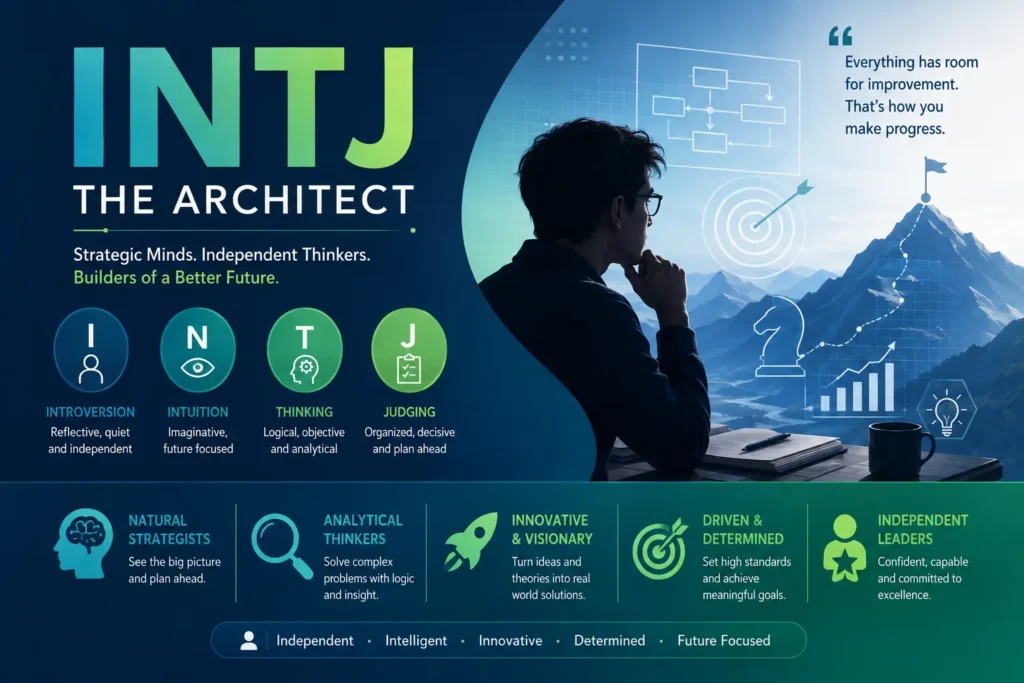
INTJ is one of the 16 personality types in the Myers-Briggs Type Indicator (MBTI) framework. Often described as strategic, analytical, independent, and future-oriented, INTJs are known for their ability to understand complex ideas, develop long-term plans, and turn ideas into practical solutions.
They tend to value knowledge, competence, independence, logic, and continuous improvement. They often set high standards for themselves and may expect the same level of commitment and performance from others.
This complete guide explores the INTJ personality type, including its meaning, common traits, strengths, weaknesses, career choices, workplace behavior, and relationships.
Quick Overview of the INTJ Personality Type
| Characteristic | INTJ |
| I | Introversion |
| N | Intuition |
| T | Thinking |
| J | Judging |
| Common description | Strategic, analytical, independent |
| Typical focus | Knowledge, ideas, systems, long-term goals |
| Work style | Independent, structured, intellectually challenging |
| Key strengths | Strategic thinking, determination, problem-solving |
| Common challenges | Over-analysis, perfectionism, impatience, emotional communication |
Note: Personality types are useful for self-reflection and understanding preferences, but they should not be treated as fixed labels or complete descriptions of an individual.
What Does INTJ Mean?
The four letters in INTJ represent four personality preferences:
I – Introversion
Introversion describes a preference for directing attention and energy inward. INTJs often enjoy spending time alone, thinking deeply, and working independently. They may prefer a small number of meaningful relationships rather than a large social circle.
N – Intuition
Intuition represents a preference for looking beyond immediate facts and focusing on ideas, possibilities, patterns, and the future.
INTJs often enjoy asking questions such as:
- Why does this happen?
- How can this system be improved?
- What could happen in the future?
- Is there a better way to solve this problem?
T – Thinking
Thinking refers to a preference for using logic, analysis, consistency, and objective information when making decisions.
INTJs generally want to understand the reasoning behind a decision rather than simply accepting it because someone else recommends it.
J – Judging
Judging represents a preference for structure, planning, organization, and making decisions.
INTJs often like to know where they are going and how they intend to get there. They may prefer having a plan rather than leaving everything open-ended.
Common Traits of INTJ Personality Type
INTJs are often described as strategic thinkers and long-term planners. They enjoy understanding how things work and finding ways to improve systems, processes, and ideas.
Some common INTJ traits include:
- Independent and self-directed
- Analytical and logical
- Strategic and future-oriented
- Curious and intellectually driven
- Highly determined
- Confident in their abilities
- Focused on efficiency and improvement
- Comfortable working with complex ideas
- Strong problem-solving ability
- High personal standards
- Prefer meaningful and intellectually stimulating conversations
- Often comfortable working independently or in small groups
INTJs are generally less interested in routine for its own sake. They tend to prefer work and activities that provide opportunities to learn, solve problems, develop ideas, and create improvements.
INTJ – The Strategic Thinker
INTJs are often associated with strategic thinking because they naturally tend to look at the bigger picture and consider long-term consequences.
They may be particularly interested in understanding systems, identifying weaknesses, developing strategies, and finding efficient solutions.
One of their notable characteristics is the ability to move from idea → strategy → plan → action.
For example, an INTJ may not simply identify a problem. They may want to understand:
- Why the problem exists
- What is causing it
- What alternatives are available
- Which solution is most efficient
- How the solution can be implemented
- How the outcome can be improved
This combination of analysis and planning can make INTJs effective in fields involving strategy, science, engineering, technology, finance, research, management, and problem-solving.
Strengths of INTJ Personality Type
Understanding strengths is an important part of personality development. INTJs can use their natural strengths to improve their performance, relationships, and career development.
1. Strategic Thinking
One of the major strengths of an INTJ is the ability to think strategically.
They tend to look beyond immediate problems and consider long-term consequences. They can connect different pieces of information and develop plans to achieve a desired outcome.
2. Independent
INTJs are generally comfortable working independently.
They often trust their own judgment and are willing to take responsibility for their decisions. They do not always need continuous supervision and may perform particularly well when given autonomy.
3. Analytical and Logical
INTJs enjoy analyzing information and understanding how things work.
They often approach problems by breaking them into smaller components, identifying patterns, evaluating alternatives, and searching for logical solutions.
4. Determined and Hardworking
When INTJs have a meaningful goal, they can be highly persistent.
They are often willing to invest considerable time and effort in achieving their objectives, particularly when they believe the goal is worthwhile.
5. Curious and Open to Learning
INTJs tend to have a strong interest in learning.
They may enjoy exploring new concepts, theories, technologies, and systems. Their curiosity can encourage lifelong learning and continuous personal development.
6. Quick to Understand Complex Ideas
INTJs can be comfortable dealing with complex theoretical or abstract information.
They often enjoy subjects that require analysis, reasoning, pattern recognition, and problem-solving.
7. Confident in Their Abilities
INTJs can have strong confidence in their ability to understand problems and find solutions.
This confidence can help them take on challenging projects and pursue ambitious goals.
However, confidence is most effective when balanced with openness to feedback and alternative perspectives.
Weaknesses of INTJ Personality Type
Every personality preference has potential strengths as well as challenges. Some characteristics that help INTJs succeed can become weaknesses when taken too far.
Recognizing these tendencies can help INTJs develop greater self-awareness.
1. Over-Analytical
INTJs may spend too much time analyzing a problem.
Their desire to find the best possible solution can sometimes lead to unnecessary complexity, delay, or stress.
Learning when to stop analyzing and start acting can be valuable.
2. Perfectionism
INTJs often have high standards.
This can motivate excellent performance, but it can also create frustration when their own performance—or the performance of others—does not meet their expectations.
Learning to distinguish between important perfection and unnecessary perfection can help.
3. Can Appear Judgmental
Because INTJs naturally analyze situations, they may quickly evaluate ideas, decisions, or behaviors.
If they communicate their evaluation without considering the other person’s perspective, they may appear overly critical or judgmental.
4. Can Appear Arrogant
Strong confidence in their reasoning can sometimes be interpreted as arrogance.
An INTJ may become impatient when they believe another person has not considered an issue carefully enough.
Listening actively and acknowledging alternative viewpoints can help balance this tendency.
5. Highly Independent
Independence is a major strength, but excessive independence can become a weakness.
INTJs may sometimes prefer doing things themselves rather than asking for help or involving others.
This can create difficulties in teamwork and relationships.
6. May Find Emotional Communication Difficult
INTJs generally prefer logic and analysis when dealing with problems.
However, not every problem requires a logical solution. Relationships often require empathy, emotional support, patience, and understanding.
Developing emotional communication skills can therefore be particularly valuable for INTJs.
INTJ Personality Type and Career Choices
INTJs often prefer careers that provide opportunities for problem-solving, intellectual challenge, independence, strategy, and continuous learning.
Rather than choosing a career solely because it is considered suitable for an INTJ, individuals should also consider their interests, skills, values, education, and career goals.
Career Areas That May Suit INTJs
Potential career areas include:
- Science and research
- Engineering
- Information technology
- Computer programming
- Data analysis
- Financial analysis
- Accounting and auditing
- Economics
- Actuarial science
- Architecture
- Strategic planning
- Business management
- Consulting
- Law
- Medicine
- Research and academia
- Writing and technical communication
- Entrepreneurship
INTJs may particularly enjoy careers where they can analyze problems, develop strategies, work with complex information, and improve systems.
Why These Careers May Suit the INTJ Personality Type?
Several INTJ characteristics can support these career choices:
Analytical thinking
They can enjoy examining information and solving difficult problems.
Strategic thinking
They often prefer thinking about long-term objectives and planning how to achieve them.
Independence
They may perform well when given autonomy and responsibility.
Intellectual curiosity
They often enjoy learning new concepts and dealing with challenging subjects.
Problem-solving
They may find satisfaction in identifying inefficiencies and developing better solutions.
Career Environments INTJs May Find Less Appealing
INTJs may find some work environments less satisfying when they involve:
- Highly repetitive tasks
- Very little intellectual stimulation
- Excessive supervision
- Rigid procedures without clear purpose
- Limited opportunities for improvement
- Constant social interaction without sufficient independent work
- Work that provides little opportunity for problem-solving
However, this does not mean that an INTJ cannot succeed in these environments. Individual interests, skills, experience, and circumstances are more important than personality type alone.
INTJs in the Workplace
INTJs can bring several valuable qualities to the workplace.
They often enjoy solving complex problems, improving systems, developing strategies, and finding more efficient ways of doing things.
They may prefer working independently or in small groups, particularly when they are surrounded by competent and intellectually stimulating colleagues.
INTJs often value:
- Autonomy
- Competence
- Efficiency
- Continuous improvement
- Intellectual challenge
- Clear objectives
- Freedom to develop solutions
- Opportunities to implement ideas
INTJ as a Manager or Leader
INTJs can be effective managers when their strategic abilities are combined with strong people-management skills.
They may excel at:
- Strategic planning
- Problem-solving
- Project management
- Long-term planning
- Process improvement
- Decision-making
- Developing innovative solutions
Their challenge as managers can be the people side of leadership.
An INTJ may naturally focus on objectives, efficiency, and solutions while employees may also need recognition, encouragement, empathy, and emotional support.
A successful INTJ leader therefore benefits from balancing strategic thinking with emotional intelligence.
INTJ as a Colleague
INTJs often prefer colleagues who are competent, independent, and willing to exchange ideas.
They may contribute valuable analysis and innovative solutions to a team.
However, their direct communication style can sometimes be perceived as blunt or overly critical.
Building strong interpersonal relationships and adapting communication to different personalities can help INTJs become more effective team members.
INTJ as a Subordinate
INTJs can be valuable employees because they often bring analytical ability, independence, and problem-solving skills to their roles.
They may prefer managers who:
- Give them reasonable autonomy
- Explain the purpose behind decisions
- Value competence
- Encourage new ideas
- Provide intellectually challenging work
- Avoid unnecessary micromanagement
They may become frustrated when they believe that rules or decisions lack a logical purpose.
INTJ Personality Type in Relationships
INTJs tend to take important relationships seriously.
They often prefer deep and meaningful relationships rather than maintaining a very large social circle.
They may value:
- Intellectual connection
- Trust
- Independence
- Loyalty
- Honesty
- Personal growth
- Meaningful conversations
Because INTJs tend to be independent and analytical, their approach to relationships can sometimes be different from that of more emotionally expressive personality types.
INTJ as a Spouse or Romantic Partner
An INTJ partner may be loyal, committed, and focused on building a strong long-term relationship.
They may show affection through actions, problem-solving, commitment, and helping their partner achieve goals, rather than through frequent emotional expression.
However, their high standards can sometimes create difficulties.
An INTJ may become overly critical or focus on how a relationship can be improved rather than simply appreciating what is already working.
They may also unintentionally overlook their partner’s emotional needs when concentrating too heavily on logic and solutions.
Learning to listen without immediately trying to solve the problem can greatly improve communication.
INTJ as a Parent
INTJ parents may encourage their children to become:
- Independent
- Intelligent
- Responsible
- Curious
- Self-reliant
- Capable of making their own decisions
They may encourage children to explore their interests and develop their potential.
However, high expectations can sometimes become a challenge.
Children may need emotional reassurance and encouragement rather than solutions or criticism. INTJ parents can therefore benefit from balancing independence and high standards with warmth, empathy, and emotional support.
INTJ as a Friend
INTJs may prefer a small circle of close friends rather than many casual friendships.
They often value friends with whom they can:
- Exchange ideas
- Discuss interesting subjects
- Learn new things
- Have meaningful conversations
- Maintain mutual independence
An INTJ may need considerable personal space and may not communicate frequently with friends.
However, limited communication does not necessarily mean a lack of care. For many INTJs, friendship is based more on depth, trust, and intellectual connection than constant interaction.
INTJ Personality Type: Strengths and Challenges at a Glance
| Strengths | Potential Challenges |
| Strategic thinking | Over-analysis |
| Independent | Excessive independence |
| Analytical | Can overlook emotions |
| Determined | Perfectionism |
| Curious | May become impatient |
| Confident | Can appear arrogant |
| Problem-solving | Can be overly critical |
| Future-oriented | May struggle with spontaneity |
The same characteristic can sometimes be both a strength and a challenge.
For example, high standards can lead to excellent performance, but excessive perfectionism can create stress. Similarly, independence can increase productivity but can also make teamwork more difficult.
How INTJs Can Develop Their Personality
Personality development does not mean changing who you are. Instead, it involves understanding your natural tendencies and developing the skills needed to function effectively in different situations.
INTJs can benefit from:
1. Practising active listening
Do not immediately analyze or solve every problem. Sometimes people simply want to be heard.
2. Accepting different approaches
A different approach is not necessarily an inferior approach.
3. Developing emotional intelligence
Understanding emotions—both your own and those of others—can improve leadership and relationships.
4. Reducing unnecessary perfectionism
Not every task requires the perfect solution. Sometimes a good solution implemented well is better than a perfect solution that never gets implemented.
5. Asking for help
Independence is valuable, but collaboration can produce better outcomes.
6. Communicating ideas with empathy
A logically correct idea may still be poorly received if it is communicated without considering the feelings and perspectives of others.
Famous People Often Associated with INTJ
Various public figures have been described as INTJ in personality-type discussions, including Isaac Newton, Stephen Hawking, John Nash, Bobby Fischer, Martina Navratilova, Woodrow Wilson, C. S. Lewis, Ayn Rand, Sylvia Plath, Elon Musk, and Mark Zuckerberg.
However, personality types assigned to public figures are often based on interpretation rather than verified personality assessments. Therefore, these examples should be treated as illustrative rather than definitive.
Is INTJ a Good Personality Type?
There is no single “best” personality type.
INTJs have characteristics that can be valuable in areas such as strategic thinking, research, technology, leadership, problem-solving, and innovation. At the same time, they may need to consciously develop skills related to emotional communication, flexibility, and collaboration.
The goal of understanding your personality type should not be to decide whether your type is “good” or “bad.”
Instead, use it to understand:
What comes naturally to me?
What challenges me?
What skills should I develop?
How can I work better with people who think differently from me?
Frequently Asked Questions (FAQ) About INTJ Personality Type
Final Thoughts on the INTJ Personality Type
The INTJ personality type is often associated with strategy, independence, intelligence, planning, and continuous improvement.
INTJs can excel when they are able to use their analytical abilities to solve meaningful problems and pursue challenging goals. Their independence and high standards can become powerful strengths when balanced with flexibility, empathy, collaboration, and emotional awareness.
Understanding your INTJ personality is not about putting yourself into a box. It is about recognizing your natural preferences, understanding your potential blind spots, and developing the skills that help you perform better in your career, workplace, relationships, and everyday life.
If you identify with the INTJ personality type, use your strengths as a foundation—but continue developing the areas that do not come naturally.
Self-awareness is the beginning of personality development.
Explore the 16 Personality Types
INTJ is only one of the 16 personality types. Explore the complete guide to discover the characteristics, strengths, weaknesses, career possibilities, workplace behavior, and relationships associated with all 16 types.