
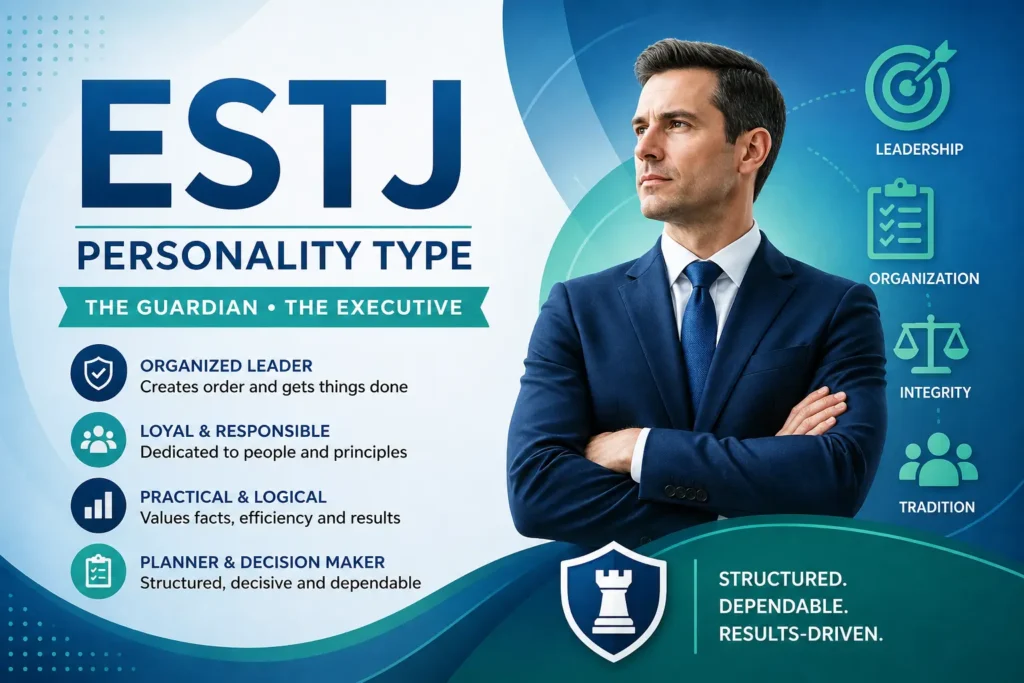
ESTJs are generally described as practical, organized, responsible, and action-oriented people who value structure, stability, and clear expectations. They often prefer dealing with facts and practical realities and may enjoy taking responsibility for organizing people, tasks, and activities.
People with an ESTJ preference may be confident in making decisions, committed to their responsibilities, and comfortable working within established rules and systems. They may also have a strong sense of duty toward their family, organization, and community.
However, personality type describes tendencies rather than fixed characteristics. Every ESTJ is different, and individual behavior is also influenced by education, experience, culture, environment, values, and personal development.
What Does ESTJ Stand For?
ESTJ is one of the 16 personality types described by the Myers-Briggs Type Indicator (MBTI). The four letters represent:
- E – Extraversion: Generally gains energy from interaction with people and tends to be active and outwardly engaged.
- S – Sensing: Generally focuses on facts, details, practical information, and present realities.
- T – Thinking: Tends to use logic, consistency, and objective considerations when making decisions.
- J – Judging: Generally prefers structure, organization, planning, and having decisions settled.
Together, these preferences are commonly associated with a practical, structured, and decisive approach to life and work.
Common Traits of ESTJ Personality Type
ESTJs are often associated with a strong sense of responsibility and an ability to organize people and activities. They may prefer clear expectations and established procedures and can be comfortable taking charge when a situation requires direction.
Some common ESTJ personality traits include:
- Practical and realistic
- Hardworking and responsible
- Organized and structured
- Loyal and dependable
- Direct and straightforward
- Strong-willed and decisive
- Comfortable taking responsibility
- Interested in facts and practical information
- Respectful of rules, traditions, and established systems
- Good at organizing activities and resources
- Comfortable working with people
- Focused on achieving clear results
ESTJs may feel more comfortable when expectations, responsibilities, and procedures are clearly defined. At the same time, they can adapt when they recognize the practical value of a new approach.
ESTJ – The Guardian
ESTJs are sometimes described as “The Guardian” because of their tendency to value responsibility, order, stability, and established standards.
They may take their responsibilities toward family, work, and community seriously. Their practical approach can make them effective at organizing activities, establishing procedures, and ensuring that responsibilities are completed.
ESTJs may also be comfortable in leadership positions because they are often willing to make decisions and take responsibility for outcomes. Their direct communication style can make expectations clear to others.
However, the same characteristics can create challenges. A strong preference for established procedures may sometimes make unconventional approaches difficult to accept, while a direct communication style may occasionally be perceived as overly forceful.
Strengths of ESTJ Personality
Understanding strengths is an important part of personality development. Some commonly associated strengths of ESTJs include the following.
1. Loyal and Reliable
ESTJs often take commitments seriously. They may place considerable importance on their responsibilities toward family, friends, colleagues, and organizations.
When they make a commitment, they generally try to fulfill it. This can make them dependable people whom others can rely on to complete responsibilities.
2. Dedicated and Persistent
ESTJs can be highly dedicated to completing tasks. They may continue working even when a project becomes difficult or repetitive.
Their sense of responsibility can help them stay focused on achieving an expected outcome rather than abandoning a task when difficulties arise.
3. Strong-Willed
ESTJs can have strong convictions about how tasks should be completed. Once they have considered the available information and formed an opinion, they may be determined to follow through with it.
This determination can help them overcome obstacles and complete demanding responsibilities.
4. Excellent Organizers
Organization is one of the commonly associated strengths of ESTJs. They may be comfortable creating plans, assigning responsibilities, establishing procedures, and monitoring progress.
These qualities can be particularly useful when a situation involves several people, tasks, or deadlines.
5. Good at Creating Order
ESTJs often prefer structure and clear expectations. They may naturally try to bring order to situations that appear confusing or disorganized.
By establishing roles, procedures, schedules, and priorities, they can help teams move toward clearly defined objectives.
6. Honest and Direct
ESTJs are often straightforward in communication. They may prefer expressing their opinions clearly rather than communicating indirectly.
This directness can make expectations and feedback easier to understand, although it is also important for ESTJs to consider how their communication style affects others.
7. Practical Problem Solvers
ESTJs generally prefer practical information and concrete solutions. When facing a problem, they may focus on the available facts, identify the immediate requirements, and work toward an actionable solution.
Their combination of organization, decisiveness, and practical thinking can be useful in situations requiring implementation.
Weaknesses and Challenges of ESTJ Personality
Every personality preference has potential challenges. The following characteristics may become difficulties when they are expressed too strongly or without flexibility.
1. Can Become Judgmental
ESTJs may develop strong ideas about what is correct, responsible, or appropriate. When this becomes excessive, they may find it difficult to accept approaches that differ from their own.
Learning to distinguish between “different” and “wrong” can help develop greater flexibility.
2. May Focus Too Much on Facts
A strong preference for facts and logic can be useful in decision-making. However, some situations also require attention to emotions, relationships, and individual circumstances.
ESTJs can benefit from considering both objective information and the human side of a situation.
3. May Place Too Much Importance on Social Expectations
ESTJs may value reputation, responsibility, social standards, and recognition. These can motivate them to work hard and maintain high standards.
However, excessive concern about external expectations can sometimes cause a person to neglect personal needs, interests, or alternative ways of achieving success.
4. May Find It Difficult to Relax
Because ESTJs often take responsibilities seriously, they may remain focused on work, duties, and maintaining order.
Making time for rest, recreation, and informal activities can help maintain balance.
5. Can Become Stubborn or Inflexible
Strong convictions can be a strength, but they can become a weakness when a person refuses to reconsider an approach despite new information.
Developing the habit of asking “Is there a better way?” can help ESTJs remain open to useful alternatives.
6. May Prefer Tradition Over Unconventional Approaches
ESTJs may appreciate established systems and methods that have already demonstrated their usefulness. However, an excessive preference for traditional approaches can make experimentation and innovation more difficult.
Being willing to evaluate new ideas based on evidence rather than rejecting them simply because they are unfamiliar can be an important area of development.
ESTJ in the Workplace
ESTJs often prefer workplaces where responsibilities, expectations, procedures, and organizational structures are reasonably clear. Their organizational ability and sense of responsibility can be valuable in many professional settings.
ESTJ as a Manager or Leader
As managers, ESTJs may naturally focus on planning, organization, accountability, and results. They may establish clear procedures and expectations and monitor whether tasks are completed as planned.
Their direct communication style can help employees understand what is expected of them.
However, effective leadership also requires flexibility. An ESTJ manager may benefit from listening carefully to alternative viewpoints, encouraging innovation, and allowing employees some freedom in how they accomplish their responsibilities.
ESTJ as a Colleague
As colleagues, ESTJs may be dependable, productive, and willing to take responsibility for team tasks. They may contribute by organizing activities, clarifying responsibilities, and keeping work focused on practical outcomes.
They are often comfortable expressing their opinions directly. This can be useful for problem-solving, but colleagues may sometimes prefer a softer approach, particularly when discussing disagreements.
ESTJ as a Subordinate or Employee
ESTJs may perform well when they understand the objectives, responsibilities, and standards associated with their role. They can be dedicated employees who take organizational commitments seriously.
They may prefer clear instructions and a well-defined working structure. At the same time, they may question approaches that appear inefficient or poorly organized.
Their workplace effectiveness can increase when they combine their natural sense of responsibility with openness to feedback and alternative methods.
Career Choices for ESTJs
ESTJ personality characteristics can be compatible with many careers involving organization, responsibility, practical problem-solving, decision-making, and clear objectives.
However, personality type should not determine a career choice by itself. Education, qualifications, interests, skills, values, experience, financial circumstances, and career opportunities are also important.
Some ESTJs may find aspects of the following career areas compatible with their preferences:
- Management and administration
- Business and entrepreneurship
- Banking and financial services
- Accounting and auditing
- Finance and financial management
- Operations management
- Project management
- Government and public administration
- Law and related fields
- Military and public safety roles
- Business analysis
- Technical and specialist roles
- Leadership and supervisory positions
ESTJ Work Environment
ESTJs may particularly appreciate work environments that provide:
- Clear responsibilities
- Defined objectives
- Organizational structure
- Practical challenges
- Opportunities to take responsibility
- Measurable outcomes
- Stable procedures
- Opportunities for leadership and advancement
Highly repetitive or poorly structured environments may be less engaging for some ESTJs, particularly when they have little opportunity to take responsibility or improve how work is organized.
Rather than avoiding a particular profession solely because of personality type, it is more useful to consider whether the actual responsibilities and work environment match the individual’s interests, abilities, and goals.
ESTJ in Relationships
ESTJs often take their relationships seriously and may demonstrate commitment through responsibility, reliability, and practical support.
Their preference for stability and structure can influence how they approach relationships with partners, children, and friends.
ESTJ as a Partner
ESTJs may value loyalty, honesty, commitment, stability, and shared responsibilities in a relationship.
They may express affection through practical support and by taking responsibility for important matters. They may also appreciate relationships in which expectations and long-term goals are clearly understood.
However, their direct communication style and strong opinions can sometimes create disagreements. A partner may interpret excessive directness or rigidity as a lack of sensitivity.
Listening, emotional communication, and willingness to compromise can help create healthier relationships.
ESTJ as a Parent
ESTJ parents may place considerable importance on responsibility, discipline, good habits, and social values. They may establish clear expectations and encourage children to become responsible and independent adults.
Their structured approach can provide children with consistency and clear boundaries.
However, parenting also requires flexibility and emotional understanding. Children may not always respond positively to strict expectations, so balancing discipline with listening, encouragement, and emotional support can be valuable.
ESTJ as a Friend
ESTJs can be loyal and dependable friends who are willing to provide practical help when needed. They may enjoy organized activities and may take an active role in maintaining social relationships.
Their straightforward nature can make their opinions clear. However, strong opinions and a preference for established ways of doing things may occasionally create disagreements.
Giving friends space to express different viewpoints can help ESTJs build stronger and more flexible friendships.
Personality Development for ESTJs
Understanding personality preferences is most useful when it supports personal growth. ESTJs can build on their natural strengths while consciously developing areas that may be challenging.
Some useful areas of development include:
1. Develop Flexibility
Not every situation requires the same method. Being willing to experiment with different approaches can help ESTJs respond more effectively to changing circumstances.
2. Practice Active Listening
Listening to understand rather than listening only to respond can improve both professional and personal relationships.
3. Consider Emotions Alongside Facts
Facts and logic are important, but people and relationships also matter. Developing emotional awareness can improve communication and decision-making.
4. Be Open to New Ideas
An unfamiliar approach is not necessarily an ineffective approach. Evaluating new ideas objectively can help ESTJs discover better solutions.
5. Learn to Relax
Achievement and responsibility are important, but rest and recreation are also necessary for maintaining long-term well-being and balance.
6. Reconsider Strong Opinions
Having strong convictions can be valuable. At the same time, being willing to change an opinion when reliable new evidence appears is an important strength.
Famous People Associated with ESTJ
Some public figures have been identified or popularly described as having an ESTJ personality type, including Steve Ballmer, Billy Graham, Michelle Obama, and Theresa May.
However, personality-type classifications of public figures should be treated cautiously. Unless a person’s MBTI assessment is publicly documented, assigning a personality type to a historical or public figure is interpretive rather than a confirmed fact.
Frequently Asked Questions About ESTJ Personality Type
Explore the 16 Personality Types
INTP is only one of the 16 personality types. Explore the complete guide to discover the characteristics, strengths, weaknesses, career possibilities, workplace behavior, and relationships associated with all 16 types.
→ Explore the 16 Personality Types