
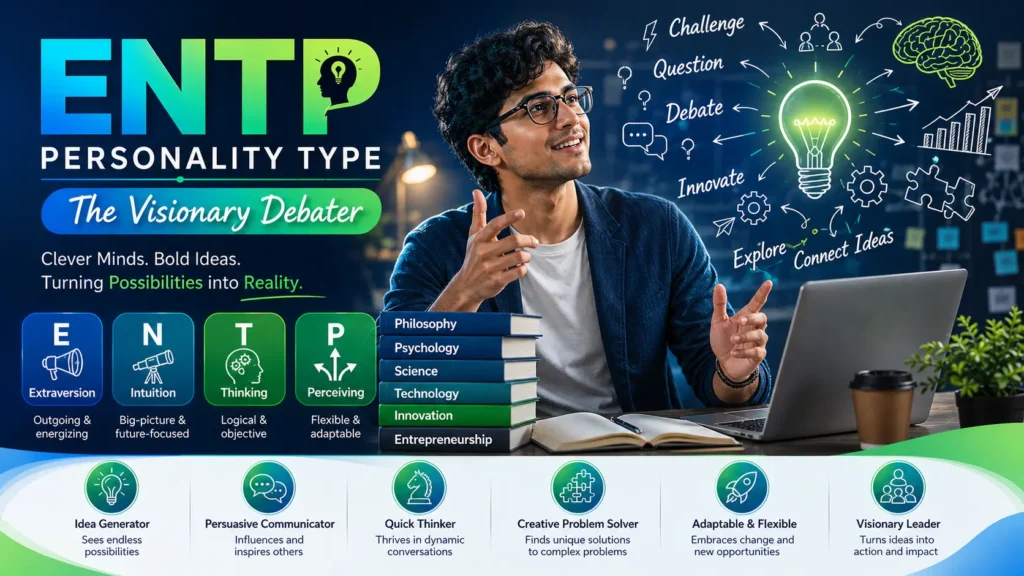
ENTPs are generally described as curious, creative, intellectually quick, and open to new possibilities. They often enjoy exploring ideas, questioning existing assumptions, discussing different perspectives, and finding innovative solutions to complex problems.
The ENTP personality type is one of the 16 personality types in the Myers-Briggs Type Indicator (MBTI) framework. ENTPs are often associated with intellectual curiosity, flexibility, communication skills, creativity, and a willingness to challenge conventional approaches.
Understanding an ENTP personality type can provide useful insights into how a person approaches ideas, decisions, work, relationships, and personal development.
What Does ENTP Stand For?
ENTP stands for Extraversion, Intuition, Thinking, and Perceiving.
These four preferences describe different aspects of how the ENTP personality type is represented within the MBTI framework.
E – Extraversion: ENTPs generally gain energy from interacting with the external world. They may enjoy discussions, exchanging ideas, and engaging with other people.
N – Intuition: ENTPs tend to focus on possibilities, patterns, concepts, and future opportunities rather than concentrating only on immediate details.
T – Thinking: ENTPs generally prefer to evaluate information using logic, analysis, and objective considerations when making decisions.
P – Perceiving: ENTPs tend to prefer flexibility and keeping options open rather than following rigid plans or structures.
Together, these preferences form the ENTP personality type.
Common Traits of ENTP Personality Type
ENTPs are often characterized by their curiosity, creativity, intellectual energy, and willingness to explore different possibilities.
They may enjoy discussing theories, questioning assumptions, and looking for alternative ways of solving problems. They can quickly understand new concepts and may be particularly interested in subjects that provide intellectual stimulation.
Commonly associated ENTP traits include:
- Creative and imaginative
- Curious and intellectually oriented
- Quick-thinking
- Flexible and adaptable
- Comfortable exploring new ideas
- Interested in theories and possibilities
- Enjoys intellectual discussions and debates
- Good at identifying alternative solutions
- Communicative and socially energetic
- Willing to question established approaches
- Values freedom and independence
However, these characteristics should be understood as tendencies rather than rules. Individual ENTPs can differ considerably depending on their experiences, environment, interests, and personal development.
ENTP – The Visionary
ENTPs are sometimes described as Visionaries because they often enjoy exploring possibilities and imagining new ways of doing things.
They may quickly identify alternative approaches to a problem and enjoy experimenting with ideas. Their curiosity can lead them to explore several subjects and perspectives rather than remaining committed to one conventional approach.
ENTPs may particularly enjoy situations where they can:
- Explore new ideas
- Question existing assumptions
- Solve intellectually challenging problems
- Discuss different viewpoints
- Experiment with alternative approaches
- Develop innovative solutions
Their enthusiasm for possibilities can be valuable in situations requiring creativity and innovation. At the same time, having many ideas can sometimes make it difficult to maintain focus on one idea until implementation is complete.
Strengths of ENTP Personality Type
ENTPs may have several characteristics that can be valuable in academic, professional, and social situations. Their strengths are often connected with curiosity, flexibility, communication, and problem-solving.
1. Good Learners
ENTPs often have a strong desire to learn. They may explore new subjects simply because they find them interesting and enjoy expanding their knowledge.
Their curiosity can encourage continuous learning and exposure to different ideas.
2. Flexible and Quick-Thinking
ENTPs are generally comfortable changing their approach when circumstances change. They may quickly move between ideas and consider different ways of approaching a problem.
This flexibility can be useful when dealing with uncertain or changing situations.
3. Open to New Ideas
ENTPs often enjoy examining new ideas rather than accepting traditional approaches without questioning them.
They may be willing to consider unconventional perspectives when those ideas provide useful possibilities or explanations.
4. Good at Brainstorming
The ability to generate multiple possibilities can make ENTPs active contributors during brainstorming and creative problem-solving.
They may be particularly comfortable producing alternative solutions and connecting seemingly unrelated ideas.
5. Strong Communication Skills
ENTPs often enjoy discussing ideas with other people. Their interest in intellectual conversations can help them communicate concepts, explain alternative viewpoints, and participate actively in discussions.
6. Energetic and Confident
When they are interested in a subject, ENTPs may demonstrate considerable enthusiasm and energy.
Their confidence can help them participate actively in discussions and present unconventional ideas.
7. Willing to Learn from Mistakes
ENTPs may be receptive to feedback and willing to reconsider an approach when they recognize that it does not work.
This willingness to learn can support continuous personal and professional development.
8. Problem-Solving Ability
ENTPs often enjoy intellectually challenging problems. Their ability to consider multiple possibilities can help them identify unconventional approaches to complex situations.
Weaknesses and Challenges of ENTP Personality Type
Every personality type has characteristics that can become challenging when overused. For ENTPs, some challenges may arise from their strong preference for novelty, debate, flexibility, and exploration.
1. Argumentative Tendencies
ENTPs may enjoy debating ideas and challenging assumptions. While intellectual debate can be productive, excessive arguing can create tension when other people interpret the discussion as personal criticism.
Learning when to debate and when to listen can therefore be valuable.
2. Difficulty Maintaining Focus
The availability of new ideas can sometimes distract ENTPs from an existing project.
They may become interested in a new possibility before completing the previous one, particularly when the original task becomes repetitive.
3. Easily Bored by Routine
Highly repetitive or predictable activities may provide less intellectual stimulation for an ENTP.
This can make maintaining motivation difficult when a role contains a large amount of routine work.
4. Difficulty with Implementation
ENTPs may generate ideas quickly but can sometimes find the detailed implementation of those ideas less interesting.
Turning ideas into completed results may therefore require deliberate planning, prioritization, and follow-through.
5. Impatience with Different Viewpoints
ENTPs may become impatient when others do not accept an idea that appears logically convincing to them.
Developing patience and recognizing that people can approach a problem from different perspectives can improve communication.
6. Insensitivity During Debate
A strong focus on logic and argument can sometimes cause emotional considerations to receive less attention.
An ENTP may intend to challenge an idea rather than a person, but the other person may experience the communication differently. Developing emotional awareness can help prevent unnecessary conflict.
ENTP in the Workplace
ENTPs may prefer workplaces that provide intellectual stimulation, flexibility, and opportunities to explore new ideas.
They may enjoy environments where they can question existing processes, contribute suggestions, solve problems, and respond to changing circumstances.
ENTP as a Manager or Leader
An ENTP manager may encourage employees to contribute ideas and experiment with alternative approaches.
Their communication skills, flexibility, and willingness to consider new possibilities can be useful in leadership roles.
They may also be comfortable acknowledging mistakes and learning from feedback.
However, an ENTP manager may need to pay particular attention to communication style. Directly pointing out weaknesses or challenging employees’ ideas can sometimes be perceived as harsh.
Developing empathy, active listening, and people-management skills can therefore complement their analytical and creative strengths.
ENTP as a Colleague
ENTPs may contribute energy, ideas, and problem-solving ability to a team.
They may enjoy discussing possibilities with colleagues and are often willing to consider alternative suggestions.
They can also identify weaknesses in existing plans, which can help teams identify potential problems before implementation.
However, continuously challenging established ideas can sometimes create friction with colleagues who prefer stability or a more structured approach.
ENTP as a Subordinate
ENTP employees may prefer a degree of independence in how they perform their responsibilities.
They may respond positively to managers who explain objectives clearly while allowing reasonable flexibility in execution.
They may also appreciate opportunities to contribute ideas rather than simply following established procedures.
Highly rigid environments, strict hierarchies, and repetitive responsibilities may provide less satisfaction for some ENTPs.
Career Choices for ENTPs
Personality type should not be used to determine a person’s career by itself. Education, skills, interests, qualifications, experience, values, financial circumstances, and opportunities are also important.
However, understanding ENTP preferences can help identify work environments that may provide greater intellectual stimulation.
ENTPs may find roles involving some combination of problem-solving, innovation, communication, research, strategy, or variety interesting.
Potential career areas include:
- Research and science
- Engineering
- Technology and software
- Consulting
- Business and entrepreneurship
- Management
- Marketing
- Human resource management
- Law
- Psychology
- Finance and financial analysis
- Research and analytics
- Writing and creative fields
- Strategy and innovation
The important point is not that these are “ENTP careers,” but that some ENTPs may find aspects of these fields compatible with their interests and preferred ways of working.
Work Environments ENTPs May Prefer
Some ENTPs may particularly appreciate workplaces that offer:
- Intellectual challenges
- Opportunities to generate ideas
- Freedom to explore alternatives
- Variety in assignments
- Opportunities for learning
- Open communication
- Flexibility
- Opportunities to solve complex problems
Conversely, highly repetitive work or environments with little opportunity to question or improve existing processes may be less engaging for some ENTPs.
ENTP in Relationships
ENTP characteristics can also influence relationships with partners, family members, and friends.
They may value intellectual connection, openness, independence, and opportunities to share ideas.
ENTP as a Partner
ENTPs may enjoy relationships in which partners can openly exchange ideas and explore new experiences together.
They may value intellectual compatibility and personal growth and may enjoy introducing new experiences into the relationship.
However, their desire to continually improve situations can sometimes be perceived as criticism. Their debating style may also create unnecessary tension if every disagreement becomes an intellectual argument.
Learning to distinguish between a situation that needs solving and one that simply requires emotional understanding can be valuable.
ENTP as a Parent
ENTP parents may encourage children to explore ideas, question assumptions, and develop independent opinions.
Their curiosity and willingness to consider alternatives can create an environment where children feel encouraged to explore.
At the same time, consistency and routine may require deliberate attention. Children may also need emotional support and quality time rather than only intellectual guidance.
ENTP as a Friend
ENTPs may enjoy friendships involving conversation, humour, intellectual discussions, and shared interests.
They can be energetic and engaging friends and may enjoy discussing new ideas or exploring different viewpoints.
However, their debating tendencies can sometimes become frustrating for friends who are looking for emotional support rather than an analytical discussion.
Is ENTP a Good Personality Type?
There is no single “best” personality type.
ENTPs have characteristics that can be valuable in areas such as innovation, communication, entrepreneurship, research, problem-solving, strategy, and creative thinking. At the same time, they may benefit from consciously developing skills related to focus, implementation, patience, emotional awareness, and consistency.
The purpose of understanding personality type should not be to decide whether a type is “good” or “bad.”
Instead, it can be used to ask:
What comes naturally to me?
What challenges me?
What skills should I develop?
How can I work better with people who think differently from me?
Famous People Associated with ENTP
Several well-known people have been described as ENTPs in personality-type resources, including Leonardo da Vinci, Thomas Edison, Richard Feynman, Theodore Roosevelt, Alfred Hitchcock, and Walt Disney.
However, personality-type classifications of historical figures and celebrities are often based on interpretation rather than documented MBTI assessments. They should therefore be treated as approximate rather than definitive.
Personality Development for ENTPs
Understanding strengths and challenges can be more useful when it leads to practical development.
An ENTP may benefit from deliberately developing:
- Focus: Complete important tasks before moving to the next interesting idea.
- Execution: Convert ideas into specific actions, deadlines, and measurable outcomes.
- Patience: Allow others time to understand and evaluate new ideas.
- Emotional awareness: Consider how communication affects other people.
- Listening: Understand another person’s position before challenging it.
- Consistency: Build routines for tasks that are necessary but less stimulating.
- Prioritization: Not every interesting idea needs immediate attention.
The goal is not to eliminate natural ENTP characteristics. Instead, personality development can involve learning when and how to use those characteristics effectively.
Frequently Asked Questions
Explore the 16 Personality Types
INTP is only one of the 16 personality types. Explore the complete guide to discover the characteristics, strengths, weaknesses, career possibilities, workplace behavior, and relationships associated with all 16 types.